Cook's language is unvarnished and plain, as a sailor's should be. His incidents, though often related with circumstance, are without exaggeration; indeed if any fault is to be found, it is that he takes occurrences involving much labour and hardship as such matters of course, that it is not easy for the reader, especially if he be a landsman, to realise what they really entail. (Wharton 1893)

Cook's Naming Conventions
Cook's knack of finding names for localities was peculiarly happy. Those who have had to do this, know the difficulty. Wherever he was able to ascertain the native name, he adopts it; but in the many cases where this was impossible, he manages to find a descriptive and distinctive appellation for each point, bay, or island.
He seems to have kept these names very much to himself, as it is seldom the officers' logs know anything of them; and original plans, still in existence, in many cases bear different names to those finally pitched upon.
Cook's names have rarely been altered, and New Zealand and Australian places will probably for all time bear those which he bestowed.
In the orthography of his native names he was not so successful. The constant addition of a redundant "o" has altered many native sounds, such as Otaheite for Tahiti, Ohwhyhee for Hawaii; while his spelling generally has been superseded by more simple forms. This is a matter, however, in which great difficulties are found to the present day by Englishmen, whose language presents no certain laws for rendering any given sound into a fixed combination of letters. (Wharton 1893)
Cook's Journal (IV)
In reading Cook’s Journal of his First Voyage it must be remembered that it was not prepared for publication. Though no doubt the fair copies we possess were revised with the care that characterises the man, and which is evidenced by the interlineations and corrections in his own hand with which the pages are dotted.
This does not, however, in any way detract from the interest of a transcript of his record on the spot; and it is probable that an exact copy of the great navigator's own impressions, and the disentanglement of them from the other interpolated matter, will be welcome.
The eccentricities in the spelling have been preserved. A good many of these would seem to be due to Mr. Orton, the transcriber, as Cook's own letters are generally correct in their orthography. The use of the capital letter was usual at the time. (Wharton 1893)
Cook's Journal (III)
The three copies are, practically, identical, except for the period August 13th to 19th, 1770, during which the wording is often different, though the events are the same. It is not very difficult to account for this. The two first-mentioned Journals are in the handwriting of an amanuensis, Mr. Orton, the clerk. No autograph journal is, so far as is known, in existence, but some rough original must have been kept, as both copies bear internal evidence of having been written up after the lapse of an interval after the events described.
 This is markedly the case in the Australian part of the Journal. It is known that Botany Bay was at first called by Cook, Stingray Bay, on account of the number of rays caught there; but after Banks had examined his collection, and found all his plants new to science, Cook determined to call it Botany Bay. It is, however, called Botany Bay from the first in the Journals.
The name, "New South Wales," was not bestowed without much consideration, and apparently at one stage New Wales was the appellation fixed upon, for in Mr. Corner's copy it is so called throughout, whereas the Admiralty copy has "New South Wales."
It would therefore seem that about the period of the discrepant accounts Mr. Corner's copy was first made, and that Cook, in the Admiralty copy, which for this part is fuller, revised the wording of his description of this very critical portion of the voyage.
The Queen's Copy has been written with especial care, and by several different hands. It was evidently the last in point of time. (Wharton 1893)
Cook's Journal (II)

Cook's Journal (I)
Cook's Journal was in triplicate. The Admiralty Orders of the day enjoined that the captain should keep a journal of proceedings, a copy of which was to be forwarded to the Admiralty every six months, or as soon after as possible. In the case of this voyage the ship was two and a half years from England before any opportunity of sending this copy occurred. The ship was the whole of this time in new and savage lands. When Batavia was reached the duplicate of Cook's Journal was sent home, and six months later, when the ship arrived in England, the full Journal of the voyage was deposited at the Admiralty.
The Secretary of the Admiralty, Sir Philip Stephens, a personal friend and appreciator of Cook, appears to have appropriated the Batavia duplicate, as we find it in the hands of his descendants, and passing thence by sale, first to Mr. Cosens in 1868, and then in 1890 to Mr. John Corner.
The other and complete copy is still in possession of the Admiralty, though in some unexplained manner it was absent for some years, and was only recovered by the exertions of Mr. W. Blakeney, R.N.
A third copy of the Journal also terminates a few days before reaching Batavia. It is in the possession of Her Majesty the Queen, and from its appearance was kept for, and probably presented to, George III, who took great interest in the voyage. (Wharton 1893)
27th May 1768

River Thames
Moderate and fair weather; at 11 a.m. hoisted the Pendant, and took charge of the Ship, agreeable to my Commission of the 25th instant, she lying in the Bason in Deptford Yard. From this day to the 21st of July we were constantly employed in fitting the Ship, taking on board Stores and Provisions, etc.
That is the only entry in the Journal until the 21st July… but I will endeavour (no pun intended) to make at least weekly updates until then (Roger R.)
A note on "Ship's time"

Who was James Cook?

James Cook rose from the ranks of ordinary working folk. The second son of James Cook, a Yorkshire labourer, and Grace his wife, he was born on the edge of the Cleveland Hills on February 27th, 1728, in the little village of Marton, which lies about four miles south-south-east of Middlesborough, and five miles west of the well-known hill and landmark, Roseberry Topping. Eight years later his father moved to Great Ayton, which lies close under Roseberry Topping.
At the age of thirteen Cook, who did have some elementary schooling both at Marton and Great Ayton, was apprenticed to one Sanderson, a draper and grocer of Staithes, a fishing village on the coast, about fourteen miles from Ayton and nine north-west of Whitby.
A year later Cook ran away to sea, shipping at Whitby on board the Freelove, a collier belonging to the Walker brothers.
In this hard school Cook learnt his sailoring. No better training could have been found for his future responsibilities. Here he learnt to endure the utmost rigours of the sea. Constant fighting with North Sea gales, bad food, and cramped accommodation, taught him to regard with the indifference that afterwards distinguished him, all the hardships that he had to encounter, and led him to endure and persevere where others, less determined or more easily daunted by difficulties, would have hurried on, and left their work incomplete.
All details of Cook's life during his thirteen years in the merchant service are lost: what voyages he made, how he fared, whether he advanced in general knowledge, all is gone. The only fact known is that in May 1755, when Cook was twenty-seven years of age, and mate of a vessel of Messrs. Walker, then in the Thames, he, to avoid the press, then active on account of the outbreak of the war with France, volunteered on board H.M.S. Eagle, of 60 guns, as an able seaman.
Captain Hugh Palliser, who succeeded to the command of this ship in October, was certainly Cook's warmest patron, and it would appear that Cook did work superior to that of an able seaman in the Eagle. All that is really known of this time in his life, is that that ship took her share of the fighting at the taking of Louisbourg and elsewhere on the North American and West Indian Station, and returned to England in 1759.
By Palliser's interest Cook was now appointed master of the Mercury. It is therefore evident that his qualifications as a navigator recommended themselves to Palliser.
The Mercury went to North America, and here Cook did his first good service recorded, namely, taking soundings in the St. Lawrence, to enable the fleet then attacking Quebec to take up safe positions in covering the army under Wolfe. This he accomplished with great skill, under many difficulties, in the face of the enemy, much of it being done at night. He was immediately employed in making a survey of the intricate channels of the river below Quebec, and for many years his chart was the guide for navigation. Cook was indeed a born surveyor. Before his day charts were of the crudest description, and he must have somehow acquired a considerable knowledge of trigonometry, and possessed an intuitive faculty for practically applying it, to enable him to originate, as it may truly be said he did, the art of modern marine surveying.
The expedition to Quebec concluded, Cook was appointed master of the Northumberland, bearing Admiral Lord Colville's flag, and during that ship's winter at Halifax he applied himself to further study of mathematics and astronomy.
In 1762, the Northumberland being at Newfoundland during the capture of that island from the French, Cook again was employed in surveys. This attracted the attention of Captain Graves, the Governor, who conceived a high opinion of his abilities in this respect.
In the latter part of 1762 Cook returned to England and married Elizabeth Batts, daughter of a man in business at Wapping; but a few months afterwards he was called upon by Captain Graves to go again to Newfoundland to make marine surveys.
In this important work he was engaged until 1767, Captain Palliser, who succeeded Captain Graves as Governor, being only too glad to avail himself of Cook's services. (Wharton 1893)
The Crew

James Cook : Lieutenant in Command.
Zachary Hicks : Lieutenant : Died : 25 May, 1771.
John Gore : Lieutenant.
Robert Molineux : Master : Died : 15 April, 1771.
Rich. Pickersgill : Master's Mate, Master, 16 April, 1771.
Chas. Clerke : Master's Mate, A.B., 20 August, 1768, Master's Mate, 17 April, 1771, Lieutenant, 26 May, 1771.
Francis Wilkinson : A.B., Master's Mate, 20 August, 1768.
John Bootie : Midshipman : Died : 4 February, 1771.
Jonathan Monkhouse : Midshipman : Died : 6 February, 1771.
Patrick Saunders : Midshipman, A.B., 24 May, 1770 : Deserted : 25 December, 1770.
Isaac Smith : A.B., Midshipman, 24 May, 1770, Master's Mate, 27 May, 1771.
William Harvey : Lieutenant's Servant, Midshipman, 8 February, 1771.
Jos. Magra : A.B., Midshipman, 27 May, 1771.
Isaac Manley : Master's Servant, Midshipman, 5 February, 1771.
William B. Monkhouse : Surgeon : Died : 5 November, 1770.
William Perry : Surgeon's Mate, Surgeon, 6 November, 1770.
Rich. Orton : Clerk.
Stephen Forwood : Gunner.
John Gathray : Boatswain : Died : 4 February, 1771.
John Satterly : Carpenter : Died : 12 February, 1771.
John Thompson : Cook : Died : 31 January, 1771.
Sam Evans : Quarter Master, Boatswain, 6 February, 1771.
Alex. Weir : Quarter Master : Drowned : 14 September, 1768.
Thos. Hardman : Boatswain's Mate, A.B., 26 March, 1769, Sailmaker,
2 February, 1771.
John Reading : Boatswain's Mate : Died : 29 August, 1769.
Benjamin Jordan : Carpenter's Mate : Died : 31 January, 1771.
John Ravenhill : Sailmaker : Died : 27 January, 1771.
George Nowell : A.B., Carpenter, 14 February, 1771.
Isaac Parker : A.B., Boatswain's Mate, 26 November, 1769.
Robt. Anderson : A.B., Quarter Master, 16 September, 1768.
James Gray : A.B., Quarter Master, 6 February, 1771.
Robert Taylor : Armourer : Died : 1 August, 1771.
Rich. Hutchins : A.B., Boatswain's Mate, 1 September, 1769.
Joseph Childs : A.B., Cook, 1 February, 1771.
Peter Flowers : A.B. : Drowned : 2 December, 1768.
Timothy Rearden : A.B. : Died : 24 December, 1770.
John Rainsay : A.B.
William Dawson : A.B.
Francis Haite : A.B. : Died : 1 February, 1771.
Sam Jones. : A.B.
James Nicholson : A.B. : Died : 31 January, 1771.
Forby Sutherland : A.B. : Died : 30 April, 1770.
Thomas Simmonds : A.B.
Rich. Hughes : A.B., Carpenter's Mate, 14 February, 1771.
Sam Moody : A.B. : Died : 31 January, 1771.
Isaac Johnson : A.B.
Robt. Stainsby : A.B.
William Collett : A.B.
Archibald Wolfe : A.B. : Died : 31 January, 1771.
Matthew Cox : A.B.
Chas. Williams : A.B.
Alex. Simpson : A.B.. : Died : 21 February, 1771.
Thos. Knight : A.B.
Hy. Stevens : A.B.
Thos. Jones (2) : A.B.
Antony Ponto : A.B.
Jeh. Dozey : A.B. : Died : 7 April, 1771.
Jas. Tunley : A.B.
Mich. Littleboy : A.B.
John Goodjohn : A.B.
John Woodworth : A.B. : Died : 24 December, 1770.
William Peckover : A.B.
Robt. Littleboy : A.B.
Henry Jeffs : A.B. : Died : 27 February, 1771.
William Howson : Captain's Servant : Died : 30 June, 1771.
Nathl. Morey : Lieutenant's Servant.
Thos. Jones : Surgeon's Servant : Discharged : 5 November, 1770.
Ed. Terrell : Carpenter's Servant, A.B. 1 September, 1769.
Thos. Jordan : Boatswain's Servant.
Thos. Matthews : Cook's Servant.
Danl. Roberts : Gunner's Servant : Died. : 2 February, 1771.
John Thurmand (Pressed at Madeira) : A.B. : Died : 3 February, 1771.
MARINES.
John Edgecombe : Sergeant R.M.
John Trusslove : Corporal : Died : 24 January, 1771.
Thos. Rossiter : Drummer.
William Judge : Private.
Hy. Paul : Private.
Danl. Preston : Private : Died : 16 February, 1771.
William Wiltshire : Private.
William Greenslade : Private : Drowned : 6 April, 1769.
Saml. Gibson : Private, Corporal, 26 January, 1771.
Thos. Dunster : Private : Died : 26 January, 1771.
Clement Webb : Private.
John Bowles : Private.
CIVILIANS AND STAFF.
Joseph Banks, Esquire.
Charles Solander : Naturalist.
Charles Green : Astronomer : Died : 29 January, 1771.
John Reynolds : Artist : Died : 18 December, 1770.
Sydney Parkinson : Artist : Died : 26 January, 1771.
Alexander Buchan : Artist : Died : 17 April, 1769.
Herman Sporing : Died : -- : 24 January, 1771.
James Roberts : Servant.
Peter Briscoe : Servant.
Thomas Richmond : Negro Servant : Frozen to death : 16 January, 1769.
George Dorlton : Negro Servant : Frozen to death : 16 January, 1769.
The Mission

Isaac Smith, one of the seamen, was a half-cousin to Mrs. Cook (he later rose to the rank of admiral). The midshipman Magra belonged to a rich and loyal New York family (he would later become British Consul at Tangier). Gore, Clerke, Molineux, Pickersgill and Wilkinson had been round the world in the Dolphin. Clerke had served in the war against
His Majesty’s Bark Endeavour
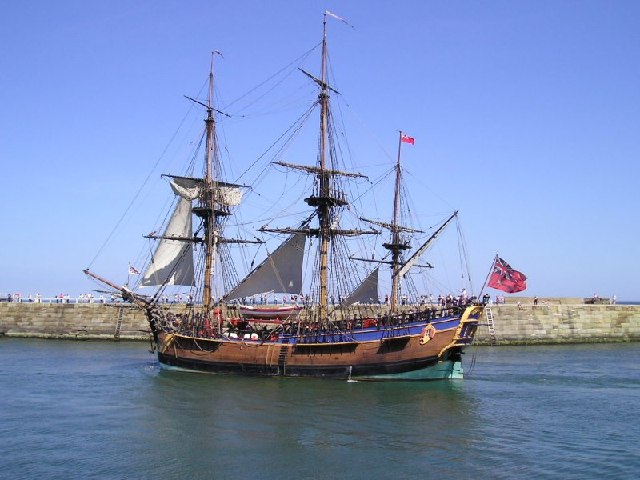
Captain Cook’s Ship on His First Global Circumnavigation, Endeavour's flat bottom was well suited for sailing along coasts in shallow waters and allowed the boat to be beached for the loading and unloading of cargo and for basic repairs. The addition of a third internal deck provided cabins and storerooms for men and supplies, and the Navy armed the ship with ten four-pounder cannons and twelve swivel guns. She was a “full-rigged ship,” using square sails on three masts. She measured 106 feet long and 29 feet wide, weighed 368 tons, and carried ninety-four men.
After the successful 'Darwin Beagle Diary' blog, from May 2011 I will be recording Captain James Cook's circumnavigation of the world on the Bark Endeavour. The aim is to post each entry exactly 243 years later, his first being on 27th May, 1768. We will be following his exploits day-by-day, together with the entries in the Journal kept by Sir Joseph Banks, the eminent botanist who was part of the expedition.
Subscribe to:
Posts (Atom)

 Posts
Posts

